canada, cramer and cuepat

31 10 2009

Interesting news from Canada this week – a sole-source tender has been announced for the development of an experimental urban camouflage (CUEPAT – Canadian Urban Environment Pattern) based on the metropolitan environments of Toronto, Vancouver and Montreal. The tender makes mention of CBR (chemical, biological and radiological protection) in one sentence, though there is no indication as to whether this prototype camouflage is being developed solely for use on CBR clothing.

Urban environments are notoriously difficult to design effective human personnel camouflage for, as not only is the vertically oriented, rounded, organic shape of a person out of place amongst the hard edges, flat planes and bulky volumes of the man-made environment, but there also is no such thing as a typical urban colour scheme. Any number of greys, browns, creams and greens will be found in the typical city, not to mention all the hues of the spectrum that appear on advertising space, doors, façades and shop fronts, cars, trucks and buses – you name it.

My prediction is that without some pretty clever thinking by the design team, the outcome of this program will be a FAIL for effective camouflage, but a WIN for Army fashionistas and the B.S. brigade, just like UCP (Universal Camouflage Pattern) was for the US Army.

The sole-source tender is effectively a no-bid offer to Guy Cramer and Tim O’Neill of  Hyperstealth Biotechnology Corporation,  stating as it does that  there are

no alternative sources of supply for this
requirement as no other Canadian source exists that has the
capability to design and develop digital, non-repeating
camouflage patterns using state-of-the-art fractal algorithms
and feed back loop technology, with concomitant IP protected
access to approximately 8,000 copyrighted patterns that can be
used in full support of meeting the requirement.

Although the terms of the tender allow competing companies to submit a bid, that bid must contain at least 80% goods and/or services of Canadian origin, and be submitted in writing before November 6th. Few, if any, of the other players in the digital camouflage industry are placed to take advantage of such a tightly constrained offer, meaning that however ineffective the design(s) submitted by Hyperstealth might be, the Canadian government will have no choice but to accept them.

There’s more on this story at Soldier Systems, and you can read the original tender as a pdf via this link.




transformed: Megan Fox in futuristic camo

20 06 2009

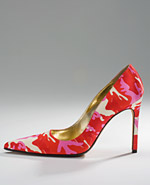
Megan Fox was at the premiere of this summer’s expected big box-office blockbuster, Transformers 2, in Berlin recently. Here’s how she could have looked if that dress was made with PenCott camouflage material…


camouflage – the exhibition comes to Canada

11 06 2009

Anyone who got to see the Camouflage exhibition at the Imperial War Museum a couple of years ago will appreciate what a treat is in store for those able to make it to the Canadian War Museum in Ottawa this summer. The IWM exhibition has travelled across the pond, and is set to inform and inspire new audiences young and old with its immersive display of concealment techniques, from their hand painted origins in the First World War through to the ultra-modern trend for uniforms designed and manufactured with the aid of sophisticated computer programs.

fashion meets function at the Canadian War Museum's camo exhibition

fashion meets function at the Canadian War Museum's camo exhibition

Follow the link to see more about Camouflage, the exhibition – from battlefield to catwalk.

Unfortunately the exhibition has no examples of the PenCott digital multi-environment camouflage, since the pattern was still being trialled when the Imperial War Museum originally presented the show. However, the two British camoufleurs who inspired Hyde Definition’s creative approach to the design of PenCott feature prominently in the Second World War gallery – Professor Hugh Cott, scientist; and artist Sir Roland Penrose. They offered solutions to the problem of concealment from two sources – that of zoological evolution and of visual psychology. At Hyde Definition we combined these points of view, and thus named the pattern in memory of Penrose and Cott: PenCott.

Camouflage is presented by the Canadian War Museum in partnership with the Imperial War Museum, from June 4, 2009 to January 3, 2010.


digital design is new special operations camo

18 05 2009

In a follow up to a story I linked to earlier this year about an unusual camouflage pattern being worn by some US Navy SEALs (special operations forces), the Soldier Systems blog has acquired some information from the Advance Planning Brief for Industry (APBI) held recently in Springfield, VA. Apparently

the Program Manager for SOF Survival, Support, and Equipment Systems announced that two camouflage patterns known as AOR1 (Desert) and AOR2 (Wooded) would be transitioned in SOF and that certain contracted systems in Khaki and Ranger Green would move to the new color schemes.

These are digital camouflage schemes not dissimilar to the camouflage already issued to the US Marine Corps (Woodland MARPAT and Desert MARPAT). Some kit and clothing has already been manufactured for trials by Beyond Tactical, London Bridge Trading (LBT) and Eagle Industries, and at one point LBT had swatches of the colour ways on their website. What the announcement seems to be saying, however, is that the camouflage is not going to be limited solely to Naval Special Warfare personnel, as had previously been thought, but is for all units operating under USSOCOM (United States Special Operations Command).

Image from LBT website

Image from LBT website

AOR2 with a vertical under different lighting conditions

Trial version (?) of AOR2 (thanks to Legit Kit NSW) with vertical alignment. Note different lighting conditions affect perceived colour.

Image from LBT website

Image from LBT website


bizarre bangladeshi bobbies

31 03 2009

Who said police work was dull? These are the subtle and understated uniforms of a Bangladeshi police unit, as seen during the country’s recent general election. Maybe there actually is such a thing as the Fashion Police.

bangladesh_police

316219f154f95f8959473920a95e8e73-grande

Hat tip to Mr E. Larson at the International Camouflage Uniform Society for bringing this to my attention. Don’t know how I could have missed it!


uber urban camouflage

6 03 2009

Thought you’d seen it all with my last entry about weird and wonderful camo applications? Think again! Here is the German take on ‘blending’ – in a supermarket!

tueten03 tueten05

See that pile of yellow carrier bags? It’s actually a bag-lady. There’s other bizarre disguises on the website, which appears to exist for the sole purpose of showcasing this (student?) project.

Thanks to Troels for the tip.


camo in the community

17 02 2009

Optical illusion meets student humour in some of the projects catalogued over on WebUrbanist.

urban-camo-main

It’s not all impractical, tax-payer funded flights of fantasy though: I particularly liked the idea of kamo kilts (for camo’d Celts?) – watch out for one of those in a neighbourhood near you!

Desert Marpat kilt

Desert Marpat kilt

Predator Fall Brown kilt

Predator Fall Brown kilt


power to the people

27 01 2009

Regular readers will remember me mentioning a design brief that my company Hyde Definition fulfilled last summer. It was to reduce the visual impact of a domestic wind turbine erected on private property in the UK, and the client wanted to be able to apply the design himself, in situ. Our website has recently been updated to include photographs of the turbine’s camouflage scheme, kindly supplied by our client.

wtpromo_grey01

Realising that it is practically impossibly to conceal an object as large and obvious as a wind turbine against the constantly changing skyscape behind it, we chose to  break up the shape and use different tones that will blend in some, but not all, conditions.

The bespoke design uses two shades of grey, plus white, applied over the black polycarbonate gearbox nacelle and triangular fin in a pixellated quadrilateral symmetry-axis disruption pattern. In plain speak, picture a flat image of the turbine head, with a line running along the centre of the nacelle, and a line running down the middle of the fin. Imagine that lines also extend inward from all the corners and join the central lines near their ends. These are the axes of internal symmetry, which is not a name for the next James Bond film, but is the central mass that needs to be broken up in order to deceive the eye, which we achieved by using square and rectangular serrated shapes in different sizes and orientations.


how the modernist movement made mariners miss

9 12 2008

I love Dark Roasted Blend. I could (and do) spend hours wandering and wondering through their vast archives of the bizarre, banal and sublime.

One particular entry, though has some crossover relevance to this blog – it’s all about the weird and wonderful dazzle camouflage designs painted on merchant and military ships during the World Wars, which provided effective deception against optical range-finding and target tracking, until seaborne radar was adopted.

USS Leviathan

Read all about it here.


do you crave gadgets?

18 08 2008

Here`s a blog for all you gadget and gizmo geardos out there. It has a camo category, which is why I`m showin` the love here. Check it out!